About the AAPA
INTRODUCTION
The Ann Arbor Preservation Alliance (AAPA) is a network of citizens and experts that promotes the cultural and economic benefits of preserving historic resources in Ann Arbor. In July, 2025, the Old Fourth Ward Association in coordination with the Old West Side Association and the Broadway Street Historic District Association decided to reactivate the AAPA with the goals of educating the public about the value of historic districts, creating a network of historic preservation supporters, and helping Ann Arbor’s revision of its Comprehensive Land Use Plan incorporate historic preservation best practices.
The AAPA emphasizes that urban development and historic preservation are mutually compatible. As Minneapolis, a city often cited as a model of pro-growth, pro-development, pro-density housing policies, says in its land use plan, "It’s critical for public engagement to include all interested groups in the preservation process, especially those whose history has been marginalized and whose places suffered deliberate disinvestment and removal. Minneapolis will work to ensure that residents of all cultures and backgrounds will have access to preservation resources while experiencing the economic, sociocultural, and emotional benefits of preservation. . . . The City will . . . help identify and preserve buildings, landscapes, and other places important to the city’s heritage. Additionally, the City will recognize and actively promote the intrinsic value of historic places as integral to the city’s evolving environment."
AAPA is an unincorporated grassroots community organization.
BACKGROUND
HISTORY OF THE ANN ARBOR PRESERVATION ALLIANCE
By Ilene Tyler
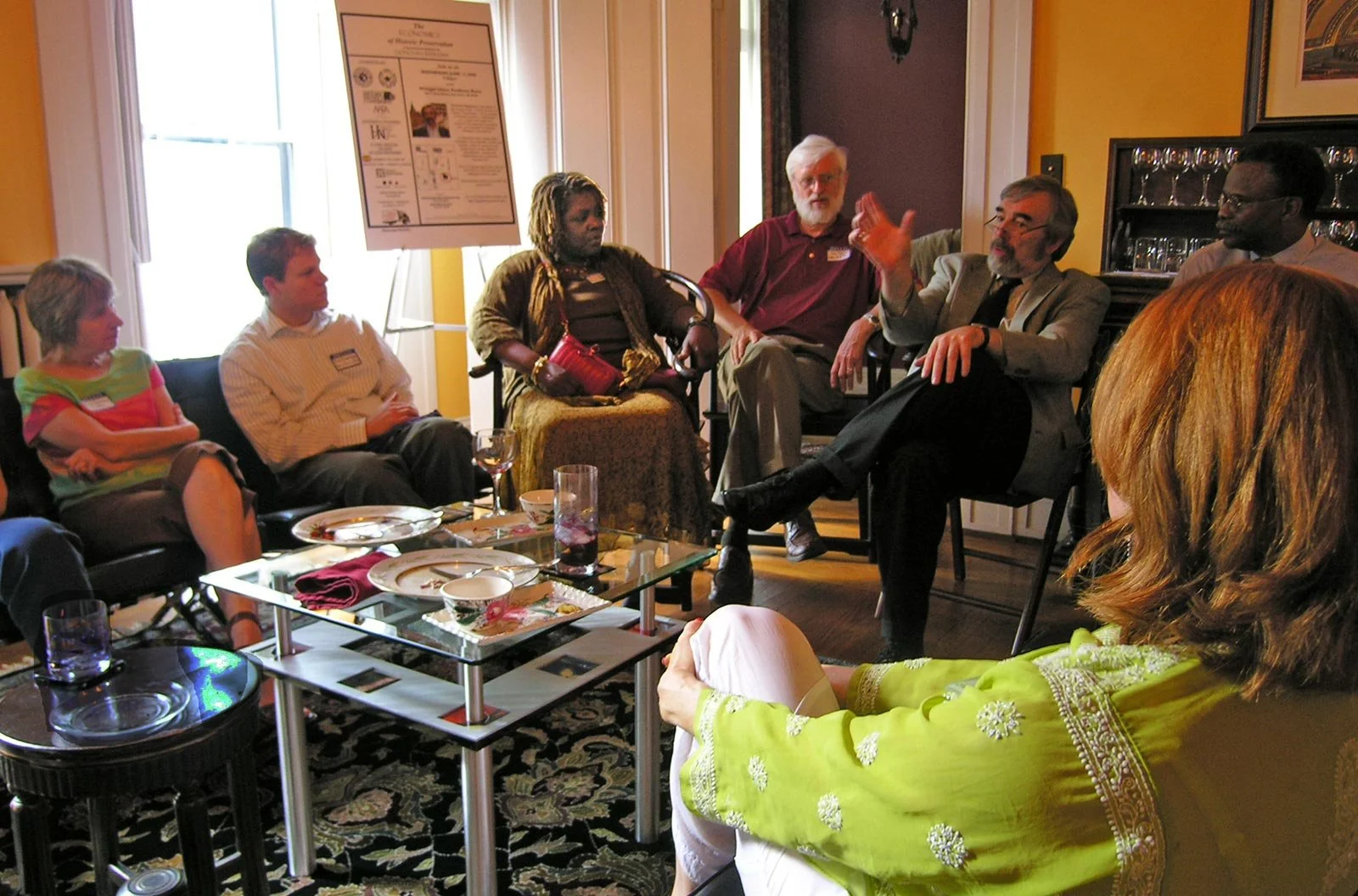
The Ann Arbor Preservation Alliance was initially conceived in 2006 with our first meeting held at Kempf House on February 2, 2006, and attended by 26 people. That roster of attendees included residents of Ann Arbor, Ypsilanti, Milan, and Toledo. Other attendees represented County and State preservation organizations. Many were current or former EMU students from its historic preservation program. At that meeting Louisa Pieper and Ilene Tyler agreed to co-chair the new organization. Together we crafted statements defining who we were, why we came together, and what we hoped to accomplish. Succinctly stated by Ray Detter, our purpose was “defending and advancing the cause of historic preservation.”
Part of what triggered this coming together was the state-mandated revisions to our historic district ordinance. Other challenges included City Council and Historic District Commission (HDC) approval of a proposed hotel on Glen Avenue. One year later, in January 2007, Louisa and Ilene drafted the following four principles and welcomed anyone wishing to take an activist role in their support to join the Alliance.
Principle 1: Support historic districts in Ann Arbor.
Principle 2: Defend the protection of designated historic properties.
Principle 3: Encourage adherence by the city to relevant sections of approved city plans, studies, and reports.
Principle 4: Support a permanent staff position for a preservation coordinator trained in historic preservation.
By May of 2007, members of the Alliance expanded this into a mission statement to promote the cultural and economic benefits of preserving the historic resources of our community. We believed this could be accomplished by focusing on Education, Advocacy, and Collaboration. Committees were formed to implement projects within each of these areas. We received a Michigan Architectural Foundation grant in 2008 to hold a series of lectures by speakers recognized nationally in their field. These lectures attracted large audiences and media coverage. We produced a brochure in 2011 that, with minor edits, is still relevant today.
Why did we stop meeting? Busy schedules and shifting personal priorities resulted in difficulty recruiting new leadership. The last meeting took place on September 9, 2009.
REVIVAL OF THE AAPA
By Jeff Crockett
Since 2023, historic districts have been challenged as an impediment to increasing density in Ann Arbor. Some people classify them as exclusionary. While people in the preservation community consider this interpretation invalid, it has been challenging to effectively counter their arguments. Researchers like Donovan Rypkema and his team at Place Economics have demonstrated time and again that preservation makes good economic sense.
Due in part to increased pressure for redevelopment and increased density, supporters of historic preservation and historic districts have taken steps to reactivate the Ann Arbor Preservation Alliance. In the Spring of 2025, in response to release of the first draft of Ann Arbor’s Comprehensive Land Use Plan (CLUP), Jeff Crockett with help from Christine Crockett, Norm and Ilene Tyler, Christine Brummer, and Tom Stulberg planned and moderated a meeting on March 5, 2025, with Historic District Coordinator Jill Thacher and City Planner Michelle Bennett to discuss the potential impact on historic districts. According to Michelle and Jill, no changes in the status of historic districts were expected in the CLUP.
The first draft contained the following statement: “Historic district boundaries will be maintained, and development will continue to adhere to the existing standards and design guidelines approved by the Historic District Commission.” The notes for that meeting can be accessed here.
With the release of the second draft of the CLUP, we became concerned. The historic district statement on p. 60 failed to mention any of the benefits that historic districts contribute to our city. These benefits are clearly articulated here. The Planning Commission also made it clear that it would oppose the formation of any new historic districts.
In response, the Old Fourth Ward Association, the Old West Side Association, and the Broadway Street Historic District Association held a meeting in late July and decided to reactivate the Ann Arbor Preservation Alliance with the goal of educating the public about the value of historic districts and creating a network of historic preservation supporters. To join the network, please click here or on the “Join the AAPA Today” button in the footer of this website. You will be on the distribution list for future communications and meeting announcements. We believe that united action is the best way to educate ourselves and to promote and preserve our historic districts.